More than 25 years’ experience · Monday–Saturday, 7am–7pm
Driveway, paving & garden services

Block paving

Bespoke block-paved driveways, paths and patios with considered patterns, borders, levels and drainage.

Free quotationNo obligationMore than 25 years’ experience
Designed around the whole site

Block paving that starts below the surface

Block paving combines individual replaceable units with a broad choice of colours, formats and laying patterns. The finish is only as reliable as the excavation, sub-base, edge restraints, falls and jointing beneath it, so we plan the whole construction rather than treating the blocks as decoration.

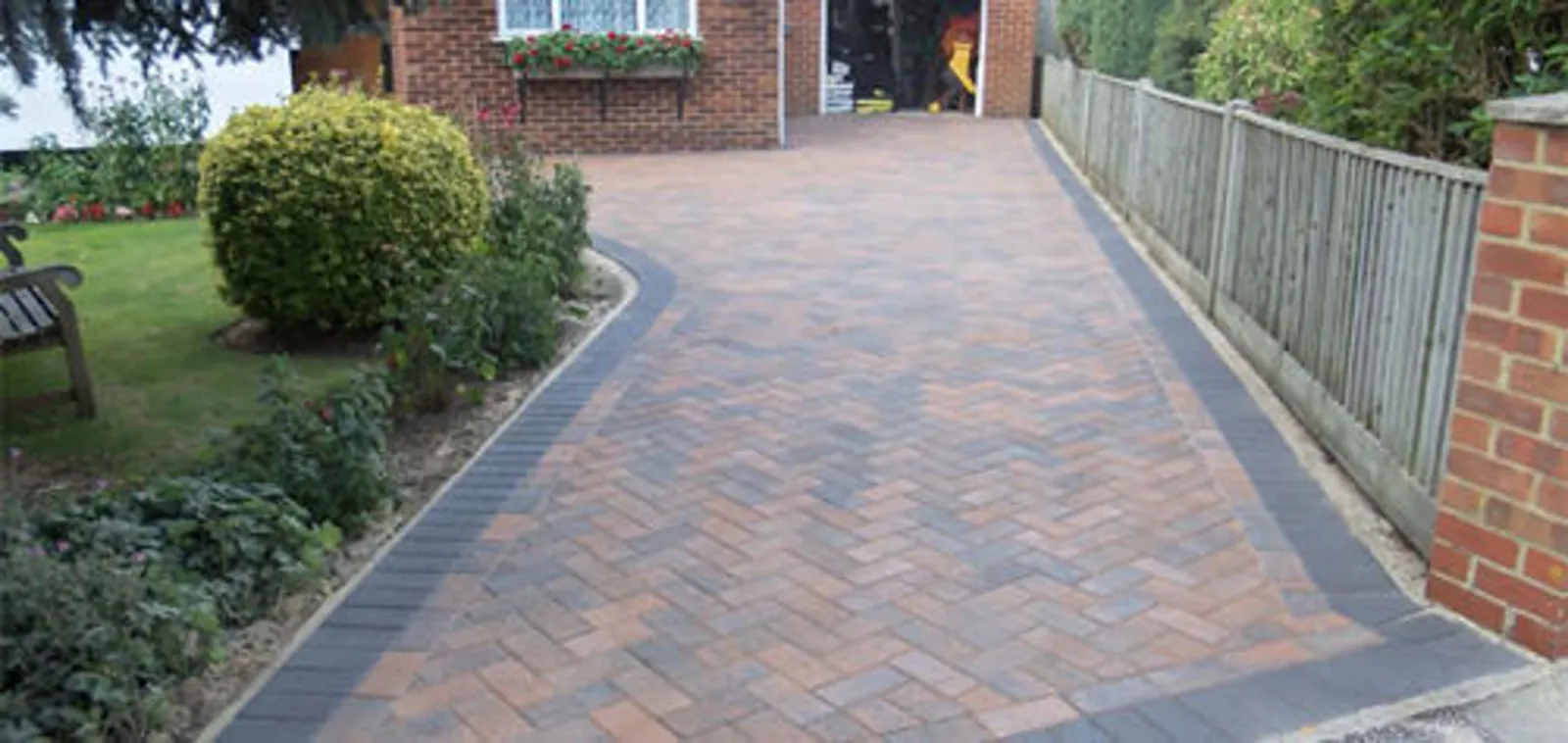
Completed herringbone block-paved driveway with contrasting border
Choosing with confidence

What to consider before choosing block paving

A useful specification balances how the area will be used with appearance, groundwork, drainage and the maintenance you are comfortable carrying out.

Use, loading and layout

Decorative driveways and parking areas and paths, entrances and coordinated patio areas can place different demands on the construction. We measure vehicle movements, pedestrian routes, furniture or garden use, then check whether the proposed layout leaves practical access around doors, gates and parked vehicles.

The intended use influences excavation, support, edge restraint and detail around covers or thresholds. It is better to settle those requirements before selecting a colour or pattern.

Finish, colour and detailing

Options can include herringbone and stretcher-bond patterns and contrasting kerbs, channels and soldier-course borders. Samples should be considered beside the property because brick, render, roof colour, shade and surrounding planting can change how a finish looks outdoors.

Borders and transitions are functional as well as decorative. They can define curves, secure an edge, separate materials and make future repairs easier to set out neatly.

Preparation and water management

The starting point is to inspect levels, access, ground conditions and drainage route. We then agree how much existing material must be removed, what supporting layers are required and where excavated material can be handled safely.

Excavate and install the specified compacted sub-base and edge restraints. Finished levels must protect damp-proof courses and door thresholds while directing rainfall towards a suitable within-boundary route.

Care, repair and realistic expectations

Interlocking patterns such as 45° or 90° herringbone are commonly considered for trafficked areas. The final choice also depends on block format, edges and the layout.

We explain routine cleaning, joint or edge checks and any product-specific aftercare before work starts. No outdoor surface is maintenance-free, but good preparation and timely local repairs can prevent small defects becoming disruptive failures.

A clear quotation should define: the measured area, preparation and disposal, construction layers, chosen finish, borders, drainage components, access assumptions and any work that is specifically excluded. This makes competing quotations easier to compare on scope rather than headline price alone. Ask how changes discovered after excavation will be agreed and recorded before additional work proceeds.

Works well for

  • Decorative driveways and parking areas
  • Paths, entrances and coordinated patio areas
  • Projects needing defined borders, curves or contrasting details

Design options

  • Herringbone and stretcher-bond patterns
  • Contrasting kerbs, channels and soldier-course borders
  • Standard and permeable block systems where the site is suitable

What we assess

  • Access, use and expected loading
  • Existing base, edges and finished levels
  • Drainage, thresholds and surrounding features
Installation

How the work is approached

The exact specification follows the site, selected product and intended use. These are the core stages we discuss during quotation.

1

Assess and set out

Inspect levels, access, ground conditions and drainage route

2

Prepare and construct

Excavate and install the specified compacted sub-base and edge restraints

3

Install and finish

Set falls, screed the laying course, lay and cut blocks, then joint and compact

Drainage and permission: front-garden surfacing, runoff and new vehicle access can need specific design or approval. See our permeable driveway guide and confirm planning/highways requirements for your property.
Dedicated local guides

Block paving in every main service area

Choose the town nearest the property for a dedicated page combining this service specification with local access, drainage, authority and nearby-area information.

Block paving in Preston

Local planning, construction and quotation guidance for Preston and nearby Fulwood and Penwortham.

View area guide →

Block paving in Blackburn

Local planning, construction and quotation guidance for Blackburn and nearby Darwen and Feniscowles.

View area guide →

Block paving in Garstang

Local planning, construction and quotation guidance for Garstang and nearby Catterall and Cabus.

View area guide →

Block paving in Clitheroe

Local planning, construction and quotation guidance for Clitheroe and nearby Whalley and Chatburn.

View area guide →

Block paving in Chorley

Local planning, construction and quotation guidance for Chorley and nearby Euxton and Buckshaw Village.

View area guide →

Block paving in Leyland

Local planning, construction and quotation guidance for Leyland and nearby Farington and Clayton-le-Woods.

View area guide →

Block paving in Bolton

Local planning, construction and quotation guidance for Bolton and nearby Horwich and Westhoughton.

View area guide →

Block paving in Wigan

Local planning, construction and quotation guidance for Wigan and nearby Standish and Shevington.

View area guide →

Block paving in Darwen

Local planning, construction and quotation guidance for Darwen and nearby Lower Darwen and Tockholes.

View area guide →

Block paving in Accrington

Local planning, construction and quotation guidance for Accrington and nearby Oswaldtwistle and Clayton-le-Moors.

View area guide →

Block paving in Burnley

Local planning, construction and quotation guidance for Burnley and nearby Padiham and Brierfield.

View area guide →

Block paving in Longridge

Local planning, construction and quotation guidance for Longridge and nearby Grimsargh and Ribchester.

View area guide →

Block paving in Penwortham

Local planning, construction and quotation guidance for Penwortham and nearby Hutton and Longton.

View area guide →

Block paving in Fulwood

Local planning, construction and quotation guidance for Fulwood and nearby Sharoe Green and Ingol.

View area guide →

Block paving in Bamber Bridge

Local planning, construction and quotation guidance for Bamber Bridge and nearby Walton-le-Dale and Lostock Hall.

View area guide →

Block paving in Horwich

Local planning, construction and quotation guidance for Horwich and nearby Blackrod and Lostock.

View area guide →

Block paving in Westhoughton

Local planning, construction and quotation guidance for Westhoughton and nearby Daisy Hill and Chew Moor.

View area guide →

Block paving in Standish

Local planning, construction and quotation guidance for Standish and nearby Shevington and Appley Bridge.

View area guide →
Questions

Block paving FAQs

Can sunken block paving be repaired?

Often, yes. Localised blocks can be lifted, the failed bedding or edge corrected and the original blocks relaid. Widespread movement can indicate a deeper sub-base or drainage problem.

Is block paving permeable?

Conventional block paving is not automatically permeable. A permeable system needs suitable blocks, open-graded layers and an appropriate discharge or infiltration design.

Which pattern works for a driveway?

Interlocking patterns such as 45° or 90° herringbone are commonly considered for trafficked areas. The final choice also depends on block format, edges and the layout.

Ask about block paving

Call, WhatsApp or send the form for a free, no-obligation quotation.

Call WhatsApp